Fishing & Nature
Sweden – for great angling
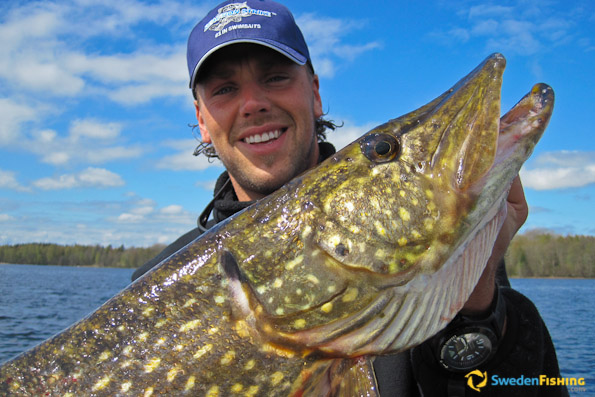
“North or south, in Sweden the chance of catching your dream fish is never far away!” Young or old, amateur or old hand the opportunities abound. Take Anna – she landed her first trout when she was six and was herself caught. The quote above is hers, but it could just as well be a comment from Sven, a city boy seduced by the fresh, unpolluted waters. She fetched him out to the countless waters rich in fish and now both are dedicated anglers spending holidays fishing in a clean, natural environment. For them the untouched countryside, the varied fauna and flora, the many lakes and rivers all combine to provide a satisfying life or just an especially exciting fishing holiday.
Easy to get to
Some 2,000 km or about 1,200 English miles long, Sweden presents wide variations in climate and of natural environments. “North and south aren’t the same,” says Sven. “But though it’s a large country, it’s easy to get around.” The high standard roads extend throughout the country, the trains and coaches are on time and there is a wide network of rental car companies. Airlines have cut their prices and introduced new classes of travel to meet the competition – and have made it possible to travel to Sweden much easier from all corners of the globe and for less money than ever.
Easy to enjoy
The fish you’re likely to catch also vary between different parts of the country, as do the preferred fishing methods and the length of the season. Generally the spring, summer and autumn provide the widest choice and often the most rewarding fishing. Use the map to put meat on this general description of the fishing opportunities and the incredible variety of sports fishing you can find all over the country. Still, this information can only begin to describe what you can expect in Sweden – this great angling country where, as Anna said, “the chance of catching your dream fish is never far away!”
Making it easy
SwedenFishing.com is your natural choice if you’re planning a fishing holiday in Sweden. We offer a variety of fishing areas and ‘fams’, all of which provide some of the best fishing in the whole of Sweden for the whole family. Wherever, whenever and how you plan to fish we are your natural partners. “SwedenFishing is great,” says Sven. “They know where to find the best fishing, the best local services, and the best fishing camps right across the country. They understand what an angler needs and can organize tailor-made packages, regardless of where you want to fish and what species you hope to catch.”
All the fishing camps on offer have high standard, personal service for anglers, such as multi-lingual guides and boats. “You’ll also get the latest information on the best places to fish and the most successful methods of fishing. Their website offers a comprehensive guide to the vast range of fishing, as well as attractive accommodations close to the best fishing waters. In short, everything you need to organize a highly successful fishing holiday can be found at SwedenFishing.com.” “SwedenFishing is great,” says Sven. “They know where to find the best fishing, the best local services, and the best fishing camps right across the country. They understand what an angler needs and can organize tailor-made packages, regardless of where you want to fish and what species you hope to catch.”
Once more – welcome to Sweden!
Better angling with fishing guides
We want our guests to have the most enjoyable and exciting fishing experiences as possible. So we asked Sven and Anna to share some tips. “To get the most out of fishing in unfamiliar waters, I suggest hiring a fishing guide for a day or a half-day,” explains Sven. “That way you’ll soon find out where, when and how you’re most likely to catch the biggest fish. And they can tell you what the best bait is right there and then.” He’s right – one of our friendly, knowledgeable fishing guides can provide valuable information and advice that will make all the difference between having a good or a bad day fishing.
Fly rod 8´- 9´ AFTM #4 or #5 with floating line.
Leaders 9-12 feet nylon.
Tippet 2x, 3x, 4x, 5x.
Gold Head Hares Ear Nymph # 10, 12, 14 in different colours.
Hares Ear Nymph # 12, 14, 16 in different colours.
Klinkhamer Emerger # 10, 12, 14, 16 in different colours.
Goddars Caddis # 10, 12, 14
Black Gnat (or other small, black fly) # 14, 16, 18
Mayfly imitations in some different colours, grey, light olive, brown # 12, 14, 16.
Fly fishing for brown trout, rainbow trout, char & grayling
Flies
Gold Head Hares Ear Nymph # 10, 12, 14 in different colours.
Hares Ear Nymph # 12, 14, 16 in different colours.
Klinkhamer Emerger # 10, 12, 14, 16 in different colours.
Goddars Caddis # 10, 12, 14
Black Gnat (or other small, black fly) # 14, 16, 18
Mayfly imitations in some different colours, grey, light olive, brown # 12, 14, 16.
Spin fishing for brown trout, rainbow trout, char & grayling
7-9 feet rod, casting weight 50-80 grams.
Good reel with 150 meter of 0.35 mm nylon line or 0.18-0.22 mm Dyneema/Kevlar.
Good quality wire leaders 30-40 cm, 30 lbs.
Wobblers & jerk baits in different sizes and colours. Zalt, Rapala, Bomber etc.
Large jigs and softbaits in different sizes and colours.
Spin fishing for pike, pike-perch
Light spinning rod 5-7 feet, casting weight up to 15-20 grams.
Small fixed-spool reel, well-filled with line.
Line; nylon 0.20-0.25 mm or 0.10-0.15 mm Dyneema/Kevlar.
Small spoons and wobblers in silver, copper, black. 5-15 grams.
Spinners in silver, copper, gold, black. 8-12 grams.
Jigs in yellow, white, black, red. 5-10 grams.
Preferably barbless, single hooks on all spinning baits for easy release of landed fish.
Fly fishing for pike, pike-perch
9 feet rod AFTM #8 or #9.
Floating WF-line for fishing in shallow water.
Slow sinking and fast Sinking Shooting lines for fishing deeper water.
Nylon or Poly leaders 0.35 mm with soft wire leader in front.
Big 10-25 cm flashabou flies, hook size 1 – 2/0. Silver/blue, green/gold, red/black.
Big Poppers or Mega Divers for shallow water.
General Equipment
Wind & waterproof jacket and trousers.
Warm underlayers, such as fleece.
Hat or cap.
Waders and wading boots.
Mosquito repellent and sunscreen.
Polarizing sunglasses.
Still and/or video camera.
Knotless (cotton) net and long-nosed pliers for easy release of landed fish.
Fishing rules
Since fishing is not part of the Right of Public Access, you‘ll need a fishing permit on most waters. POACHING IS SEVERELY PUNISHED. Always check if there are special, local rules such as minimum size, catch limits and the use of private waters, as well as off-limits areas like in the mouths of some rivers. Some sites are seasonal and some types of fishing may not be allowed in all or part of the fishery at certain times of year. Information can be found where you buy your permit. You’ll need permits or special permission to fish anywhere in Sweden except in the five largest lakes – Vänern, Vättern, Hjälmaren, Mälaren and Storsjön. Sea fishing along the whole coastline is also free.
New rules for pike in the Baltic Sea!
The Swedish National Board of Fisheries has issued new regulations in the Baltic Sea for pike. You’re only allowed to keep 3 pikes between 40 – 75 cm per angler per day. Pike below or above this length span must be released back into the water at once.
Fishing is regulated by the Fisheries Act, the Fisheries Ordinance, and FIFS, a compendium of regulations issued by the Swedish National Board of Fisheries. These statutes contain rules on numerous matters, including gear for recreational fishing. Fishing is prohibited within 100 meters of stationary fishing gear, including fish farms. Fishing with nets, trolling (with or without motor), tip-up fishing and the like are not permitted without a license. The basic rules of the Right of Public Access always apply: show consideration, don’t disturb, and don’t destroy.
And don’t be greedy!
Swedish waters are plentiful. Still, those of us who fish for enjoyment should take no more fish than we need for one day’s lunch and dinner. The rest should be released in what is sometimes referred to as “voluntary catch and release”. We prefer the term “ecological angling” – we want to make sure that our great grandchildren will be able to experience our fantastic fishing waters filled with a healthy stock of wild fish in an undisturbed environment!
How to release fish after they’re caught
– Use barbless, single hooks as much as possible or flatten the barb with a pair of pliers before fishing.
– Have long-nosed pliers at hand for easy hook removal.
– When playing a fish, bring it in as quickly as possible to avoid over-exhaustion, especially in warm waters and waters with low oxygen content. Do not use to light tackle on big fish.
– All fish have a protective slime layer on their skin and it is important that your HANDS ARE WET before handling them. When landing a fish, handle it as little as possible. For small fish, it is often possible to grasp and invert the hook to return the fish to the water without touching it.
– If you use a net, make sure it has a soft, knotless, cotton mesh net to minimize damage to the slime layer.
– Anglers will often want pictures of their trophy catch before releasing it. For large fish, grasp the tail and support the internal organs gently directly behind the pectoral fins. Keep the fish in the water and if possible avoid lifting it out.
– Some fish fight to the point of exhaustion and may need to be revived. To revive a fish, grasp it by the tail and support the internal organs gently directly behind the pectoral fins. Move the fish back and forth in the still water or point the fish upstream. Make sure the fish is revived and ready to go before releasing it.
Seasons
“From top to toe Sweden is 2,000 kilometres long. 2,000! When it’s snowing up north, southern Sweden could be thawing.” The words are those of Sven, an angler, who goes on to explain that Skåne Province in the south can be snow-free and several degrees warm, while Lapland above the Polar Circle can have 20-30°C below zero and metre-thick ice on the lakes. And that’s in March!”
“You have to remember the great climate differences when you plan a fishing holiday here in Sweden, especially if you’re going up north,” says Anna, Sven´s girlfriend. “Far up the lakes might only be open for three or four months, while in the central and southern areas they might never freeze at all.” Since the climate conditions in different parts of the country are so varied, it’s tough to offer general advice about when to come to Sweden. “For example, spinning for pike is normally very good in April down south, but up north this is the peak season for ice fishing,” says Anna. As a fishing tourist you should always take time to check when the fishing for just your species is best and where it’s best to go.”
Temperatures and daylight hours for some places in Sweden
Malmö – 55°35′N 13°2′O | |||||
Average daytime temperatures | |||||
Jan | Feb | Mar | Apr | May | June |
2 | 3 | 7 | 9 | 16 | 22 |
July | Aug | Sep | Oct | Nov | Dec |
22 | 21 | 17 | 13 | 8 | 5 |
Hours of daylight, sunrise to sunset, mid-month | |||||
Jan | Feb | Mar | Apr | May | June |
7.5 hrs | 9.5 hrs | 11.5 hrs | 14 hrs | 16 hrs | 17.5 hrs |
July | Aug | Sep | Oct | Nov | Dec |
17 hrs | 15 hrs | 13 hrs | 10.5 hrs | 8.5 hrs | 7 hrs |
Stockholm – 59°19′N 18°4′O | |||||
Average daytime temperatures | |||||
Jan | Feb | Mar | Apr | May | June |
-1 | -1 | 3 | 9 | 15 | 21 |
July | Aug | Sep | Oct | Nov | Dec |
22 | 20 | 15 | 10 | 5 | 1 |
Hours of daylight, sunrise to sunset, mid-month | |||||
Jan | Feb | Mar | Apr | May | June |
7 hrs | 9 hrs | 12 hrs | 14.5 hrs | 17 hrs | 18.5 hrs |
July | Aug | Sep | Oct | Nov | Dec |
18 hrs | 15.5 hrs | 13 hrs | 10 hrs | 8 hrs | 6 hrs |
Östersund – 63°11′N 14°40′O | |||||
Average daytime temperatures | |||||
Jan | Feb | Mar | Apr | May | June |
-5 | -3 | 0 | 5 | 12 | 16 |
July | Aug | Sep | Oct | Nov | Dec |
18 | 17 | 12 | 6 | 0 | -3 |
Hours of daylight, sunrise to sunset, mid-month | |||||
Jan | Feb | Mar | Apr | May | June |
5.5 hrs | 8.5 hrs | 11 hrs | 14 hrs | 17 hrs | 20 hrs |
July | Aug | Sep | Oct | Nov | Dec |
19 hrs | 16 hrs | 13 hrs | 10 hrs | 7 hrs | 5 hrs |
Kiruna – 67°51′18″N20°13′31″O | |||||
Average daytime temperatures | |||||
Jan | Feb | Mar | Apr | May | June |
-10 | -8 | -4 | 1 | 7 | 14 |
July | Aug | Sep | Oct | Nov | Dec |
17 | 14 | 8 | 2 | -5 | -8 |
Hours of daylight, sunrise to sunset, mid-month | |||||
Jan | Feb | Mar | Apr | May | June |
3.5 hrs | 7.5 hrs | 11.5 hrs | 15.5 hrs | 20 hrs | 24 hrs |
July | Aug | Sep | Oct | Nov | Dec |
24 hrs | 18 hrs | 13 hrs | 9.5 hrs | 5 hrs | 0 hrs |